

Created by Bastian Schurr |
What does SAP's Autonomous Enterprise strategy mean for PLM?
Under the name “Autonomous Enterprise,” SAP presented its vision for the enterprise resource planning (ERP) system of the future at SAP Sapphire 2026.
This vision outlines how companies will be managed in the future: Companies will work more intelligently and respond more quickly by managing and executing processes across various departments within a connected, adaptive system using AI assistants and agents. Humans provide instructions or define tasks; AI assistants coordinate their execution; and AI agents carry them out. For your company, this means:
- Your employees make the decisions that drive the company forward—AI agents handle the routine tasks.
- Your company reacts even before teams are assembled: When conditions change, the company acts as a unified whole. Employees coordinate with one another across the entire company in real time. There is no delay between the trigger and the action.
- You act quickly because you can trust the system: Every AI action is controlled, verifiable, and traceable. These capabilities are built into the architecture and thus integrated from the start—they weren’t added as an afterthought. Speed and control are not mutually exclusive.
What does that mean for the user, specifically?
Users begin in Joule Work, the new central entry point alongside SAP Build Work Zone. In Joule Work, users see their upcoming tasks and are notified of critical events within their area of responsibility. Users also have access to the Joule chatbox, which they can use to have Joule open their business applications or to enlist Joule’s help in completing tasks. Joule Work connects users with AI assistants that act as intelligent colleagues and use context to anticipate the user’s intent—while the user makes the decisions. The AI assistants coordinate the work of AI agents across organizational boundaries within both SAP and non-SAP systems.
What is the planned system architecture?
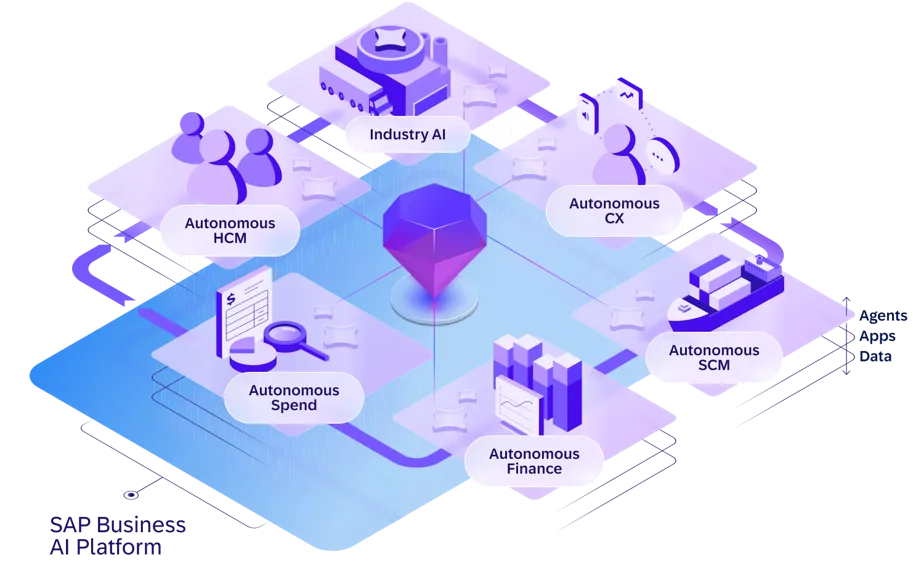
The Autonomous Enterprise consists of three main components: Joule, the SAP Autonomous Suite, and the SAP Business AI Platform.
Joule is the new user interface that connects data, workflows, applications, and agents across SAP systems—AI that takes over routine tasks so your users can focus on their important work.
The SAP Autonomous Suite forms the operational core of the enterprise. It is organized into five Autonomous Domains (Financial Management, Spend Management, Supply Chain Management, Human Capital Management, and Customer Experience). Tasks within each domain can be performed, as before, by applications, customer-specific workflows, or AI components. The major advantage of the SAP Autonomous Suite is its consistency across domains. The domains operate as a single system, and decisions are disseminated across system boundaries. The Autonomous Domains are implemented using SAP Cloud ERP and other cloud-based SAP systems, as well as non-SAP systems. SAP Industry AI adds process knowledge regarding industry-specific business processes.
SAP Industry AI was developed with the goal of automatically integrating industry standards as well as customer-specific extensions into workflows.
The SAP Business AI Platform (BAIP) serves as the foundation for technical implementation. It enables the development and operation of custom applications, workflows, and AI agents. It provides interface functionality to integrate non-SAP systems and make them ready for AI use. In addition, the BAIP enables reliable and controlled use of AI within your organization. The platform provides the semantic relationships between data models in SAP and non-SAP systems, so that AI applications can not only process your data but also understand its meaning and the relationships between data elements.
What does this mean for your PLM?
Product Lifecycle Management (PLM) falls under the Autonomous Domain Supply Chain Management (SCM). In other words, within the Autonomous Domain SCM, there is the Autonomous Subdomain PLM—or Autonomous PLM for short—which is currently SAP’s AI assistant for product design. This assistant integrates data from product design, development, and downstream processes to support change decisions, promote compliance measures, and coordinate collaboration. This results in concrete benefits for your company:
- Improved performance: Higher-quality products are delivered more efficiently.
- Cost reduction: Rework is reduced.
How does the SAP standard align with your company's specific processes and solutions?
With its AI strategy, SAP does not aim to standardize individual processes and technical expertise. Rather, the goal is to be able to adapt AI to a company’s specific requirements and expand it in a targeted manner. The BAIP makes this possible.
How is Autonomous SCM structured?
Supply Chain Management (SCM) encompasses the disciplines of Product Lifecycle Management (PLM), Supply Chain Planning, Logistics Management, Manufacturing Execution Management, Enterprise Asset Management, and Supply Chain Procurement. Each of these disciplines is organized as its own autonomous subdomain and provides its own AI assistants.
Are AI features also available with on-premises systems?
Yes. Companies can also use AI-powered assistance features in on-premises environments. The key question is not so much whether AI can be used, but rather under what technical, organizational, and economic conditions this is possible. Depending on the system landscape, integration, data provision, and operation may require more effort than in a cloud environment.
Companies should not view the decision as a choice between “AI or no AI.” Rather, it is a matter of defining the approach that makes the most sense for their specific situation. An AI roadmap helps to systematically evaluate potential, technical requirements, and the necessary investment.
Are you also being asked how you plan to use AI in your company's PLM operations?
CENIT can help you find the answer. Take advantage of CENIT’s PLM expertise and conduct an AI workshop to identify potential AI solutions for your company in the PLM area and integrate them into your AI roadmap. The AI workshop demonstrates how companies can use intelligent technologies to transform their PLM data into knowledge, innovation, and sustainable competitive advantages.
In the AI workshop focused on PLM, real-world customer use cases are analyzed to quickly achieve measurable added value through the intelligent use of data and processes. Get in touch with us!
*AI tools were used to assist with research, brainstorming, and structuring. The author bears full responsibility for the content and statements.
Let's shape your digital future together.

Buchholz Contact me now
Vice President Sales
CENIT AG