
Design, modeling and simulation: A unified entity that needs differences
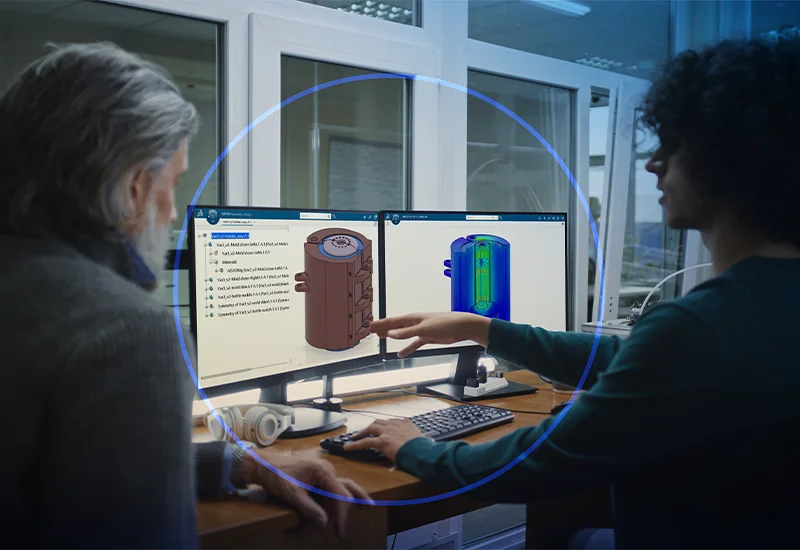
Anyone who wants to implement simulation-driven design must equip employees with the right digital roles and tools based on their tasks.
Digital transformation through simulation is in full swing. Its importance for the entire value chain will increase significantly—just think of the concept of the virtual twin. As a decision-maker with responsibility for processes, it falls to you to successfully manage these changes. This article encourages you to clearly distinguish between objectives and value contributions in simulation. Only by recognizing these differences can you implement value-adding digital collaboration.
It’s a topic that’s often discussed using various buzzwords: design-driven simulation, “frontloading,” or even “simulation for designers.” You also frequently read about the “democratization of simulation” or MODSIM, the acronym for MODeling and SIMulation.
What lies behind all these buzzwords, and where does the concept’s added value lie for the value chain? We’ll try to shed some light on this here.
Not everyone who talks about simulation means the same thing
First of all, we need to clarify what simulation is actually for. Simulation provides insight. Nothing more. Insight into products or processes, even if they don’t physically exist yet.
This “insight” can occur at various levels of abstraction. Each level represents a different perspective. The observation thus relates to different phases of the value chain and is used by different stakeholders.
There is therefore no such thing as “the” simulation. For example, the behavior of products or their development can be simulated at the system level when components and subcomponents are represented solely by their behavior, rather than by their three-dimensional design. This discipline is called model-based system simulation.
However, simulation can also take place at the level of three-dimensionally modeled components and subcomponents. This three-dimensional simulation is “normally” referred to as simulation and, just like system simulation, spans a wide variety of physical disciplines.
The simulation method must be appropriate for the problem at hand
Which level of abstraction is better? The answer comes from an analogy in cartography. Which map is better—a road atlas or a city map? Clearly, it depends on what kind of insight into the geography is needed.
Simulation at the system level or using three-dimensionally modeled components represents different degrees of abstraction—there is no “better” or “worse” here, just as the road atlas has its place just as much as the city map.
Now, regarding the “democratization” of simulation: design engineers, manufacturing engineers, and systems engineers gain direct access to simulation tools. This not only shifts when in the process simulation takes place—it also redefines simulation goals on a role-specific basis. The results of this process optimization speak for themselves: iterations in days instead of weeks, validated products on the first attempt, and development times that are 60% shorter. The question is no longer whether, but how quickly companies want to benefit from these time savings.
Design Improvement versus Validation for Manufacturing and Use
Many people use simulation today, but they pursue very different goals. The impression is often given that “democratization” is transferring the discipline of simulation from calculation experts to design engineers. This general impression must be refuted in its broadest sense.
While it is true that some complex simulation workflows can be automated and are thus accessible even to employees without CAE (Computer-Aided Engineering) expertise, However, if we use the technically correct term for the use of simulation in the design department, the nature of this use becomes clear: simulation-driven design. The focus remains on design; simulation is merely a tool to make the design even better.
The goal, therefore, is to support design decisions earlier and earlier through simulation—not to validate them. The simulation expert, on the other hand, does not make design decisions but rather validates the design. A completely different objective! Design engineers and simulation experts may use the same tools, but the goal of each simulation is entirely different.
MODSIM Streamlines the Value Creation Process—A Real-World Example
Example: When a design engineer designs a pressure vessel, it is a very helpful step to apply a pressure load to that vessel and perform a preliminary simulation.
Quantitatively accurate stress values cannot be expected in simulation-driven design—and how could they be, since the exact pressures are still unknown while the design process is ongoing?
However, if the result is viewed as a qualitative analysis and stress concentrations occur at certain points, the designer can eliminate them through appropriate design changes. It is evident that this improves the design without requiring quantitatively accurate stress values.
The simulation expert would have identified the undesirable stress concentrations just as well and asked the designer to make revisions—now the simulation expert can focus on problems that are not immediately apparent and that require his or her expertise to validate the product.
The number of iterations between design and simulation decreases, and the value-creation process accelerates.
Your Path to Effective Digital Collaboration in Simulation
A key aspect of simulation-driven design is the close integration with CAD, enabling the designer to launch a simulation directly from their CAD tool without interruption.
For CATIA V5 and SOLIDWORKS users, integration with the 3DEXPERIENCE platform from Dassault Systèmes enables a truly scalable MODSIM environment—ranging from integrated CAD simulation to full Abaqus functionality.
Which implementation level makes sense in each individual case depends on the specific requirements and conditions. CENIT supports companies with expert consulting to help them tap into the potential of simulation-driven design with MODSIM in a targeted and sustainable manner.
The appropriate implementation level must be determined on a case-by-case basis. CENIT is proud to have enabled many customers to realize the potential of simulation-driven design through expert consulting.
In doing so, we take a close look at the processes and begin with a consultation and the joint definition of the target vision. We clarify which roles and responsibilities should exist within the company for simulation. Based on this, we can determine how digital collaboration should be implemented in simulation.
Through simulation-driven design, the line between design and simulation becomes blurred, and everyone involved in the value creation process seamlessly integrates into what the future of value creation looks like: simulation as the heart of digitalization.
MODSIM with the 3DEXPERIENCE Platform – The Benefits for Your Company
MODSIM stands for MODeling & SIMulation: the collaborative and end-to-end use of simulation in engineering. CAD and CAE processes operate on a shared data model—no data discontinuities, no version conflicts.
On the 3DEXPERIENCE Platform, modeling and simulation are seamlessly integrated into a shared environment—with a consistent data foundation throughout the entire product development process, whether in the cloud or on-premises.
Benefits of MODSIM with the 3DEXPERIENCE® Platform
- Single Source of Truth: Simulation and modeling operate on the same data model—always up to date, without export/import loops.
- Digital Twin: MODSIM creates a digital product model that validates design decisions through simulation—without a physical prototype.
- Faster validation: New products reach the market faster because validation cycles are shortened—resulting in 60–90% shorter development times.
- Reduced development costs: More productive workflows and fewer physical prototypes thanks to early defect detection in the virtual twin.